
You know you have it in you.
Give it three focused weeks.
A structured three-week coaching experiment built around how you’re actually functioning — and something meaningful you want to change. Start with your capacity. Test what works in real life. Discover what becomes possible. Leave with a system you can keep using.

“I finally stopped chasing a million tasks and started actually enjoying life.”— Valeria, 33 · Client, Group Neurosprint
You don't need to commit to a new life — or spend years in therapy or coaching. You need a good experiment.
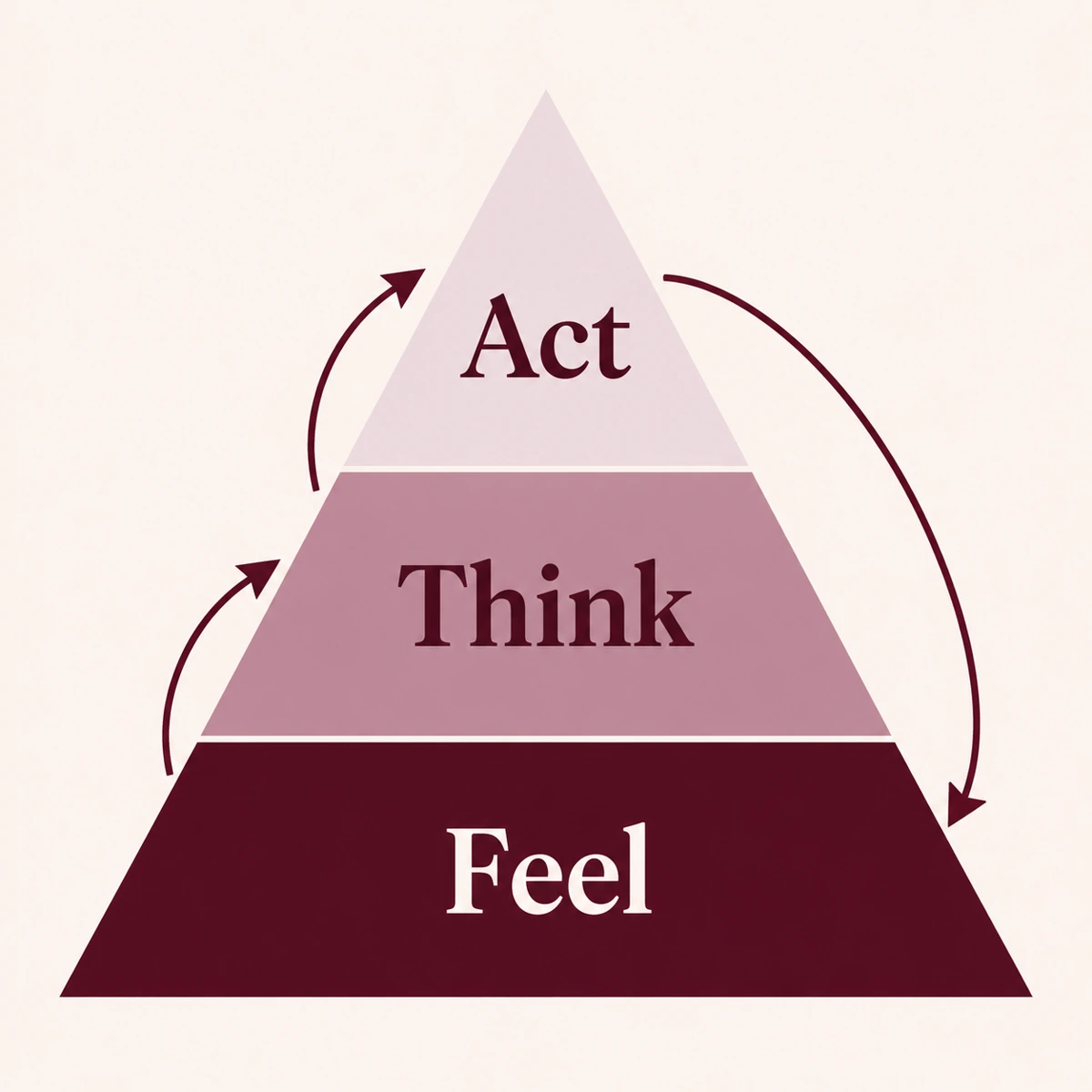
Most productivity systems fail for one reason: they treat your capacity to act like it's fixed.
It isn't. How you're feeling shapes how you think. How you think shapes what you're able to do. A plan that skips that first link asks you to perform the action while ignoring the state that makes it possible — which is why willpower runs out and the plan quietly dies.
So instead of starting with the plan, we start with where you actually are. From there we form a hypothesis: what might make this part of my life work better, given your real capacity right now? You try it in real conditions, watch what happens, adjust, and learn.
Most people discover they're capable of far more than they assumed — not by pushing harder, but by finally working with their own state instead of against it. Three weeks is long enough to see that shift, and short enough that the downside stays small.
You leave with a result, better information about yourself, and more agency over what happens next.
Bring the thing that’s been stuck.
It can be practical, personal, or still a little undefined. You do not need to arrive with a perfectly clear goal.
Something keeps getting postponed.
A decision, project, exam, application or change you care about — but never seem to have the right time or energy for.
You know there must be a better way to run your life.
Work is swallowing recovery, planning creates guilt, or every new system asks more of a capacity that already feels stretched.
You want to test a different way.
A new routine, boundary, career direction or way of working — without turning it into a huge irreversible life decision.
You want to know what else is possible.
Not escape your life. Explore it: what changes when you give a different version of yourself a real chance to operate?
Six real sprints. Six very different results.
These stories are condensed from real client Neurosprints and shared in a simplified form for privacy.

Sharon, 42 · Account Director
“I am competent — and I don’t have to work fifteen hours to prove it.”
“My focus is just to survive this day.”
Protect recovery first: a consistent bedtime, a 6pm work stop, leaving the flat — then slowly reintroduce things that felt like life again.
She finished a book, cooked, spent real time outside, and stopped treating 15-hour days as proof of competence. By the end of two sprints, she had made a decision and applied for an MSc — the first real step toward creating her own education course for her industry.

Kristina, 37 · Director, Studio School of Arts
“Better to invest one month in yourself than keep barely coping with everything, every single day.”
After running the School of Arts during the day, she still faced 5–8 hours of admin, often late into the night.
Use the Group Neurosprint to finally build the online booking system she had postponed for years.
Admin dropped to about two hours a day. She reported sleeping through the night again and getting evenings and family time back.

Anastasia, 44 · Owner, Skin Cosmetology Clinic
“A system that actually supports me, instead of stressing me out.”
“The to-do list just made me feel guilty.”
Replace rigid scheduling with a lighter system of reminders, goals and progress that could flex with the reality of running a clinic.
The mental load dropped enough for her to finally develop a long-delayed growth idea: her own sun-tanning product line.

Vlad, 40 · Software Engineering Manager
Stopped waiting for three free hours. Started using the fifteen minutes he actually had.
A driving test had been sitting untouched for months, while a stressful leadership role at work and life with three kids kept crowding it out.
Stop waiting for the mythical three-hour free block. Use the 15–30 minutes that actually existed — in queues, between family demands, and in the gaps around work.
He passed the test. More importantly, he learned that meaningful progress could fit inside the life he already had.

Maria, 25 · Quantum Navigation Engineer
“I need to make decisions from a stable place, not out of fear of disappointing someone.”
“I need to become more disciplined and confident.”
Make decisions from a more settled state, work on her dissertation in deliberate blocks instead of exhausting pushes, and redesign her evening so mornings could work.
She held her target wake-up time through a demanding three weeks and found a steadier way to work without driving herself from fear.

Valeria, 33 · IT Security & Process Management
“Turns out I get an enormous amount done.”
“I’m not keeping up with anything.”
Test clearer expectations with leadership, start the job-search steps she had been avoiding, track wins, and protect small restorative moments instead of treating them as optional.
She started applying elsewhere, changed how she handled work pressure, and began separating her worth from her output.
A sprint, not an open-ended coaching process.
A Neurosprint borrows the useful part of Agile — short cycles, real-world feedback and rapid adjustment — but applies it to a human system. Your energy, stress, thinking patterns and capacity are part of the data, not inconveniences to push through.
Map
We unpack your intake profile to map what is actually getting in the way — your current state and capacity, default thinking loops that emerge from it, and behavioural blocks. You’ll leave with complete clarity on your current roadblocks, followed by a detailed post-call summary and recommendations.
Frame
Together we turn the goal and patterns from Map into a custom weekly sprint plan designed around your real capacity — concrete projects, tasks, time budgets and calendar slots — but also recovery, boundaries, state-regulation practices, environmental changes or deliberate constraints. The plan should make action more available, not require you to overpower yourself to follow it.
Iterate
At the end of weeks 1 and 2, we look at the evidence. What's working? What isn't? And importantly: are you struggling because the plan needs more discipline — or because your current state, thinking, environment, skill or capacity makes the action unnecessarily hard? We use the evidence instead of blaming the person, then adjust.
Integrate
At the end of week 3, we do a deep transformation reflection, name what actually changed — including the unexpected parts — and turn the useful pieces into something you can keep using without me.
The real goal isn't to need me. By the end of the sprint, you are not just carrying a result. You understand more clearly what expands or constrains your capacity, what helps you think differently, and what makes useful action easier to access. That becomes something you can keep using long after we stop meeting.
Delivered through daily stand-ups, ongoing communication, and personalised practices, prompts and materials sent through messenger — alongside your five guided sessions.
What you get
Same method. Different level of privacy and support.
Both formats follow the same three-week arc. Choose the environment that suits you.
Individual Neurosprint
One-to-one throughout. Every session, adjustment and piece of support is shaped around your context, pace and goal.
- 5 guided sessions
- Daily messenger check-ins to keep momentum and notice change and resistance so we can adapt the Neurosprint
- Personal sprint plan + tracker · created together with your coach
- Personalised practices and materials
Group Neurosprint
You run the same structure alongside a small group. The work is still yours; the group adds momentum, perspective and the feeling that you are not the only one figuring things out.
- Same five-session arc
- Daily sprint structure
- Peer accountability, perspective and cross-pollination from others’ experience
- Practices and materials curated around the group’s dynamics and shared goals
The Pattern Mapping Session · 60 minutes · CAD $125
We unpack your intake profile to understand the system you’re operating from right now: your stress and regulation capacity, the thinking patterns that tend to follow, and the behaviours that are helping or blocking you. You leave with a clearer picture of what is limiting your capacity for action — and where the most useful leverage points may be.
- Complete a guided 10–15 minute self-assessment so we have a 360° view of how you feel, think and act
- Clarify the outcome underneath the problem or possibility you arrived with
- Map what is actually getting in the way — your stress and regulation capacity, recurring thinking loops, and the behaviours that keep the pattern going
- Identify the blocks most likely to derail progress and the leverage points worth testing
- Within 48 hours you receive a finalised summary of the Pattern Mapping session, together with my recommended sprint structure and next steps.
- Decide after the session whether you want to continue; there is no obligation to book a sprint
A Neurosprint is especially useful when…
You’re capable, but you’re running too close to the edge.
Work or family carries real cognitive load and responsibility. You do not need another ambitious routine that works only when you're rested, motivated and perfectly organised. You need change built around the capacity you actually have — while life keeps happening.
Your life works on paper, but something no longer fits.
The career, routines or priorities may be perfectly functional. You simply want a structured way to find out what needs to change — without detonating everything first.
You want room to discover what else is possible.
There may be no crisis at all. You are curious what happens if you give a different idea, direction or version of yourself a fair three-week experiment.
Hi, I'm Dashima.
I'm Dashima Dambieva, a Certified Neurointegration Coach trained through the Neurointegration Institute's LA-based, ICF-aligned program. I help you understand your patterns, test useful changes, and build something sustainable.
I spent 15+ years in analytics, product and leadership at EA Sports, British Airways and Sony Mobile, followed by director-level consultancy and a Chief Product Officer role at an AI startup. Applied mathematics taught me to simplify complexity; leadership taught me to turn insight into structured progress. I bring that rigour to coaching. That means a clear method, adapted to the realities of a human life.
Raised in Buddhist philosophy, I've practised yoga and mindfulness for 15+ years and taught professionally since 2024. Breath, movement, attention and state regulation are longstanding practices in my life.
I'm also raising two children while building work of my own. Whatever we design needs to survive interrupted sleep, competing priorities and limited bandwidth — not just an ideal week.
Certified through the Neurointegration Institute's Certified Neurointegration Coach Program (LA-based, ICF-aligned) — 120 hours of theory, 180 hours of practice, 20 ICF-approved CCE credits.

Hear what the sprint felt like from the inside.
The outcome matters. So does what changed along the way — and what stayed.
"My ask was specific: less procrastination, more energy for work and family. The sprint showed me I could make real progress in small steps, without blocking off hours I didn't have. I closed a goal that had a real risk of never happening."
"I finally stopped chasing a million tasks and started actually enjoying life. I learned to separate 'want' from 'should' — and found the resource for things I'd let go of for years, like an evening out with my husband."
"It mattered to me that my trainer had lived this as a parent too. With her support and the daily reminders, I finally built habits that had eluded me for years — and there's real calm in my relationships now, not just more to do."
"The most valuable part was naming my own workaholism out loud, and the permission to adapt life to me instead of the other way around. I left every session feeling lighter, with real blind spots finally in view."
"It's not intimidating to admit something isn't working — the approach sorts through it without burying you in information. Difficulties started feeling like a challenge instead of stress, and the small-steps, test-and-see approach was genuinely interesting to live through."
"I came away with an actual structure for planning my time, and a few practices that have stuck with me well past the three weeks — plus a genuinely supportive group to go through it with."
Choose the next step that fits where you are.
Start with fifteen minutes.
Use the free Fit Check to ask questions, get a feel for working together, and see whether a Neurosprint makes sense for you.
- 15-minute Fit Check · free
- A chemistry call, not a coaching session
Go straight to Pattern Mapping.
Choose this if you already want a proper working session and want to understand what is actually blocking progress.
- Useful on its own
- You commit to a sprint only after Pattern Mapping
A few common questions.
Is this coaching, or therapy?
Neurosprint is a structured coaching format designed to create focused, measurable progress within three weeks. It is not therapy, counselling, or medical treatment. It is designed for people who are functioning in daily life and want a structured way to create change. If what you are dealing with needs clinical mental-health support, I will say so clearly rather than trying to stretch coaching beyond its role.
Do I need to already know what I want to change?
No. Many clients arrive with a general sense that something is not working rather than a perfectly formed goal. Clarifying what is actually worth working on is part of The Pattern Mapping Session.
What if three weeks isn't enough?
A Neurosprint is deliberately short — that's the point. Most clients leave with a system they keep using well past the three weeks, and some choose to run another sprint on a different area of life later.
What do the daily check-ins actually involve?
A short stand-up prompt, a relevant practice or piece of material, and space to reflect — usually a few minutes a day, not a new task list.
What does it cost?
The 15-Minute Fit Check is free. The Pattern Mapping Session is CAD $125 and is the required first working step. An Individual Neurosprint is CAD $595 for the three-week sprint after Pattern Mapping. A Group Neurosprint is CAD $295 per person after Pattern Mapping.